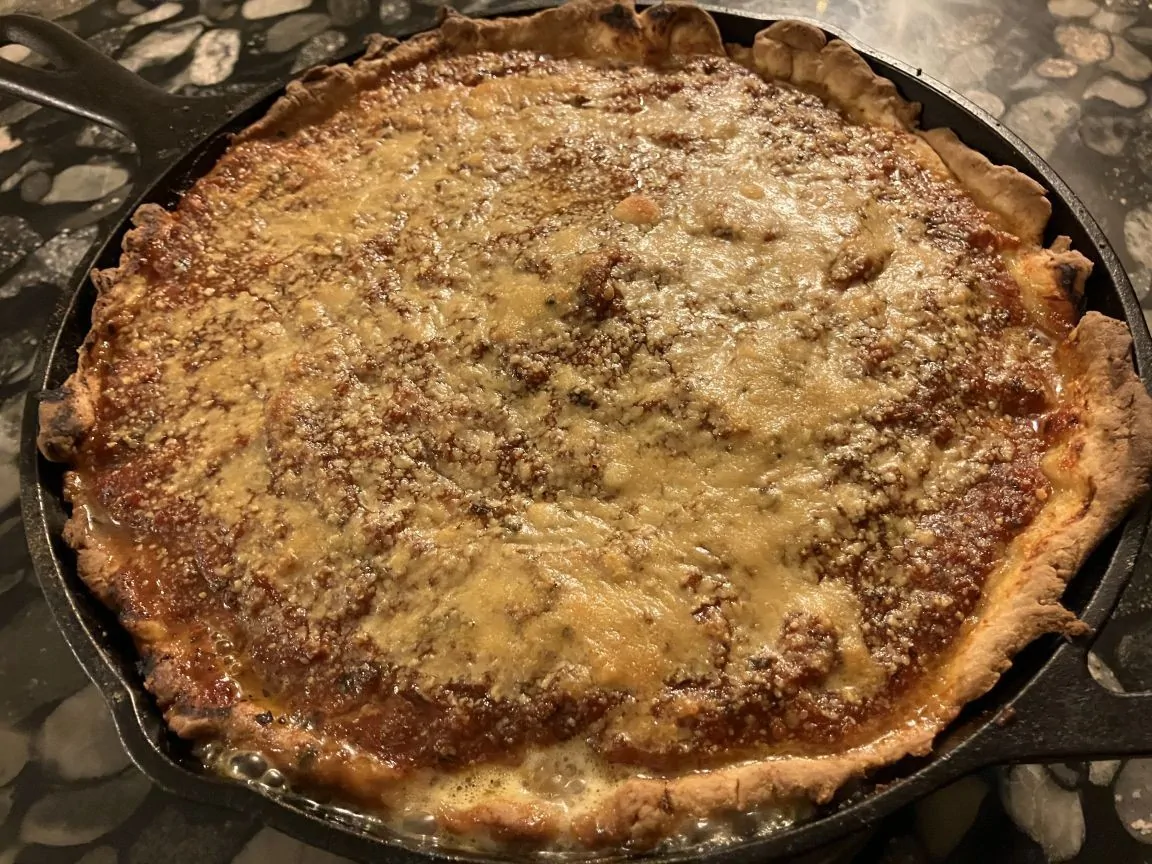
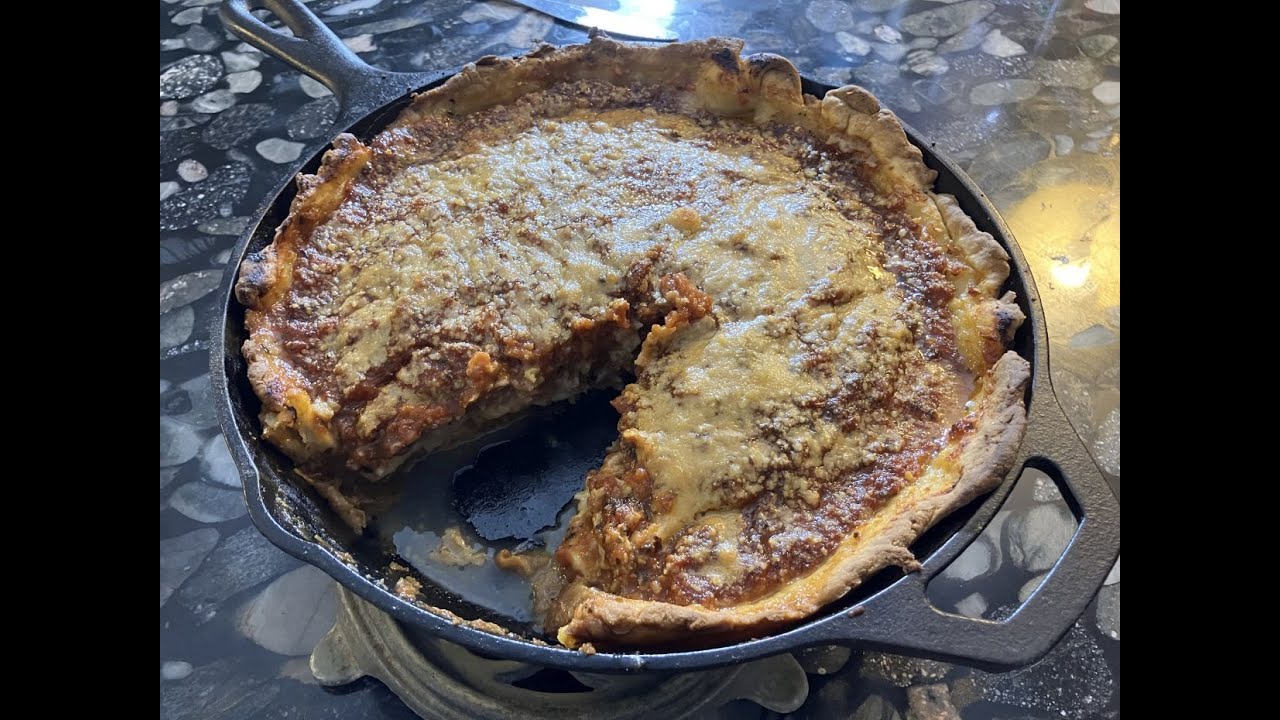
Chicago Style Deep Dish Pizza

Video can’t be displayed

  • YouTube: Chicago Style Deep Dish Pizza (in a Lodge cast iron skillet)
I'd like to go on the record and say I'm not interested in most of the battles over what we should put into our cooking so that it's the right way to make it. I love cornbread with sugar. I love chili with beans, and I also enjoy pineapple pizza. And, especially, I love me some Chicago style deep dish pizza. And so, 'tis the season for deep dish pizza, because there's no wrong time of the year for pizza.
Whether you say this is real pizza or not, there's no denying this is delicious and filling. A ten inch deep dish pizza can easily feed three or four people, and what you end up with is a cast iron skillet stuffed to the brim with tomaties, sausage, and lots of cheese. And what's there to hate about that? All I care is, it's delicious and it's fun to make, and I'll be happy to make this deep dish pizza time and again. I hope you agree that you can make whatever you want in your own kitchen, so go ahead and make your own Chicago deep dish pizza, even if you're a born and bred New Englander like I am.
Pans needed: A small dish or bowl to chill the butter. This recipe uses an electric mixer to prepare the dough. Use the mixing bowl for pizza dough, or one large bowl if you're not using a mixer; and another large bowl for pizza sauce. This pizza is best when made in a 10 inch cast iron skillet:

Ingredients

Pizza Dough:
  • 450 grams all-purpose flour
  • 40 grams corn meal
  • 12 grams sugar
  • 9 grams instant yeast
  • 6 grams salt
  • 1/2 cup (1 stick) cold butter, cut into pieces
  • 275 grams lukewarm warm water (90° to 100° Fahrenheit)
Pizza Sauce:
  • 2 tablespoons butter
  • 2 to 3 tablespoons tomato paste
  • 1 28-ounce can crushed tomatoes
  • 2 teaspoons sugar
  • 1/2 teaspoon dried basil
  • 1 teaspoon dried oregano

Pizza filling:

  • 1 pound (16 ounces) grated mozzarella cheese -- whole milk cheese if possible
  • 1 pound (16 ounces) sausage, not in the casing -- your choice of sausage (sweet or hot)
  • Grated parmesan cheese
Before measuring the ingredients, cut up 1 stick of butter into pieces, and place them into a small dish or bowl. Place the dish of butter into the freezer, to cool for 20 to 30 minutes. While the butter is in the freezer, prepare your ingredients.
Into the bowl of an electric mixer, measure and add the dry ingredients: flour, corn meal, sugar, yeast, salt. Mix the dry ingredients together, then add the cold butter to the dry ingredients and mix them together until the dough resembles pie dough in the making. At this point, add lukewarm water, a little at a time, and keep mixing in water until the dough is kneadable. Knead the dough on your countertop for only a little bit, to keep the dough soft. Place the dough back into the mixing bowl, cover the bowl, and let it rise on the counter for an hour and a half.
This gives plenty of time to prepare the pizza sauce. Heat up a cast iron skillet (you can use the same pan that will bake the pizza later), and melt 2 tablespoons of butter into the hot pan. Add 3 tablespoons of tomato paste and stir fry the tomato paste in the hot butter for about a minute. Add crushed tomatoes, and cook the sauce in the pan until it begins to thicken and reduce. Add sugar, dried basil, dried oregano and cook the sauce until it reduces and takes on the consistency of a good pizza sauce. Using a spatula, empty the pan of sauce into a bowl, and wipe the pan with a paper towel so it can be used to bake the pizza.
Unless you're using shredded cheese, be sure to grate the mozzarella cheese so it will be ready.
After an hour and a half, take the risen dough, split it in half, and put the two halves onto an oiled sheet tray. Cover this and place it in the fridge to cool for another hour. This will keep the butter in the dough from becoming too soft, and it will help to produce a crust like pie crust.

Preparing the pizza

And finally after rising the dough for two and a half hours, we're ready to make a deep dish pizza. Preheat the oven to 425° Fahrenheit.
Remove the tray with the dough balls from the refrigerator, and save one of the dough balls for another pizza later on. Wrap the dough ball in plastic and place it back into the refrigerator.
Get out a rolling pin and roll out the crust. Make sure the crust is wide enough to fit into the cast iron pan and cover the sides as well as the bottom.
Start laying on the toppings! With a Chicago style pizza, build it in reverse and start with the cheese. Cover the bottom of the dish with cheese, then for the next layer use sausage. And this is something else that's unique, in the way we're using a layer of sausage that completely covers the entire pizza. Flatten the sausage into a very thin patty and spread it entirely over the cheese. Optionally, add some white pepper and black pepper to the sausage for some more flavor. Now cover it all with the sauce. Of course we want to be generous with the sauce here, and we can do this because the layer of sausage is preventing the sauce from soaking the bottom crust. Finallt, top the pizza with a generous amount of grated parmesan cheese.
And this really thick and heavy deep dish pizza goes into the oven to bake at 425 degrees until it's done. Depending on your oven, this can take from 30 to 40 minutes.
Let the pizza rest for ten minutes, and then it's ready to be served, fresh and hot and delicious.

Cast Iron Chaos

CONTACT

Email
modemac@modemac.com
Facebook
https://www.facebook.com/CastIronChaos
Thank you!
We have received your submission.
Error
Bad respond

We use cookies to enable essential functionality on our website and analyze website traffic. For more information, read our Cookies and Privacy Policy.

Your Cookie Settings

We use cookies to enable essential functionality on our website and analyze website traffic. For more information, read our our Cookies and Privacy Policy below.

Cookie Categories
Essential

These cookies are strictly necessary to provide you with services available through our websites.

Analytics

These cookies collect information that is used in aggregate and in an anonymized form to help us understand how our website is being used and how effectively our site is performing.